 Consensus Management Using WWWConsensus Management Using WWW
HeongJu kim
darma@hic.etri.re.kr
Byungdo Go
bdgo@silla.etri.re.kr
B-ISDN Service Section
Electronics and Telecommunications Research Institute
Yusung-gu, Kajung-dong 161
Taejon, Korea
In general, consensus means unanimity of opinion. However, consensus management can be defined as a management function used to more effectively manage specific targets through appropriate-level acceptance of participant opinions. [1]
In particular, it is extremely important that intended purposes be achieved through strengthening of harmony among specific groups. In Korea, projects forming the so-called Highly Advanced Nation (HAN) goal have been in progress at government level since 1992. Of such projects in particular, development of B-ISDN, to be the basis of the information industry, is one of the most important. A variety of groups, such as research institutes, schools and enterprises, are participating in the research and development activities related to such large projects; and, to effectively execute the projects, consensus management is required.
This thesis proposes a system (HAN/B-ISDN Information System: HIC) capable of managing consensus through the use of WWW,
and describes methodology related to system realization.
The HAN/B-ISDN being pushed ahead in Korea is a large project to construct the nation's basic network: and is composed of many unit projects, and associated subprojects executed within each unit project; and all of these projects are being carried out jointly by enterprises and government-invested research institutes. During the development courses of these projects, large amounts of documentation and variously sized meetings are respectively generated and held; and, for such large projects being executed in conjunction with a variety of regionally dispersed institutions, it is extremely important to unify variegated project participant opinions and document windows, to provide the grounds for effective decision-making. Even in Korea, Internet services are growing at an extremely fast pace, thanks to active WWW utilization started in the latter part of 1994.
WWW, in particular, provides an extraordinarily flexible user interface and powerful document basis called Hypertext; and, should WWW be used as the basis, effective consensus management can be maintained. Based on such idea, implementation of HIC (HAN/B-ISDN Information Center), the WWW basic consensus management tool, is planned. Major functions of this system are, fundamentally, BBS (Bulletin Board Service); DMS (Document Management Service); ICS (Interactive Chatting Service), and ONS (On-line News Service); and, in addition, there are such supplementary functions as project progress checking, term/abbreviation checking and questionnaire taking.
Chapter 2 of this thesis first introduces the basic configuration of this system currently being realized; Chapter 3 contains content on detailed functions; and Chapter 4 contains realistic scenario examples of communication between clients and servers. Finally, this paper attempts to describe matters pertaining to planned additional functions, as well as future development directions.
2.1 System Target domain
HAN/B-ISDN is composed of 4 sections in total: i.e. the ATM switching system sector: optical transmission sector: terminal sector: and communications network technology sector; and there is a variety of large scale projects associated with these sectors. Each unit project is, then, composed of many supplementary tasks. Such large unit projects shall be carried out jointly by a number of regionally dispersed enterprises and government-invested research institutions; whilst, on the other hand, inter-organic joint action is needed between these organizations.
To realize this, functions enabling prompt opinion exchange between institutions, document exchange and project information exchange management are required.
2.2 Design Considerations
1) Network
In Korea now, Internet use has not yet become popularized. However, large enterprises and research institutions, in general, are connected to Internet, and utilization of such networks is enormously active. In the case of HIC, fast delivery of opinion and information is required; and, because enterprises or research institutions generally use 56Kbps private lines, should actual network loading be heavy, interface with, or access to, HIC may be delayed. To supplement such shortcoming, HIC connects 28.8 Kbps modem lines to 10 ports, to compensate for problems resulting from excessive network loading.
2) Performance
Performance of the current HIC system, when using SPARC-20, NCSA httpd1.4, is designed to enable processing of approximately 30,000 to 2,000,000 requests, at maximum, per day; and the system will be upgraded in the future to prevent performance deterioration corresponding to frequency of use.
3) Security
It is extremely important to protect the variety of technology-related documentation and information generated by each unit project from access by external sources and, in order to actually prevent hacker infiltration, access control, PGP and PEM, are used: whilst, at present, development of a HIC self-security system is under study.
3.1 Basic structure
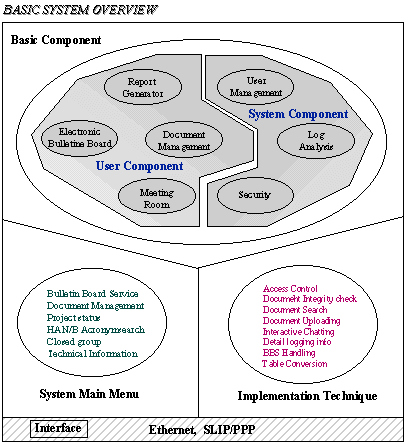
Basic HIC configuration is shown on Figure 3-1.
3.2 HIC functions in Detail
1) System
User authentication:
Because HIC service is not open to the general public, but is open only to specific user groups, user authentication is very important. To realize this, private, group and public sets have been defined, to totally manage access control.
Automatic menu production:
To enable anyone to easily manage the service, all server menu's are designed to be produced automatically. In the case of closed group, for example, there may various kinds of group. However, this system has been designed, as in the case of BBS, to enable easy construction and management of groups.
System log function:
To effectively manage the histories of all documents or announcement data, logging of all documents or files, and recalling of information, have been enabled, to allow easy history tracing through a variety of recall methods, in addition to the existing web statistics [2].
2) Users
Announcements:
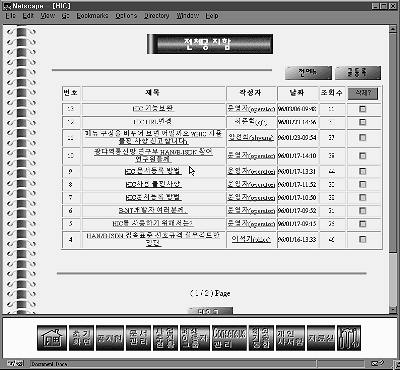
This is a column used for making announcements, if there are items to be advised of between groups, or to members, participating in the HAN/B-ISDN project. Major functions include announcement data registration and inspection. All announcement data has title, writer and date fields, and the announcement function is capable of performing the functions of electronic bulletin boards[3]& [4].
In addition, this announcements column carries functions capable of enclosing documents or files required for announcements. Documents can be prepared either in general test, or in HTML, document form. All CGI scripts are prepared in perl; bulletin boards are automatically renewed whenever new content is registered; exhibition period can freely be selected and, basically, contents are automatically erased after certain periods.
Figure 3-2 shows an electronic bulletin board screen in actual implementation.
A column used to register and manage the variety of technology-related documents and official correspondence generated during the course of development, this column contains, as major items, document inspection, registration, distribution and browsing functions. For the sake of convenience, each document can be registered at freely selected server locations through the use of programs unilaterally realized, instead of through use of the existing anonymous ftp system. When documents are registered, document information content is recorded through the use of forms which, in turn, are automatically converted to HTML document format and stored. As to document browsing, desired files can be found through the use of up to 5 main keywords and queries.
Project progress check:
A function allowing supervision of project progress at any time, effective management of the variety of unit projects, this function enables the performance records of each unit project to be recorded in specified forms: and this is automatically combined with the HTML table function, being converted into report form. All of these functions use CGI script prepared in perl.
Closed user group service:
Depending on the needs of each unit enterprise, many working groups requiring technological discussions can be formed and operated. All groups shall have common menu systems for the bulletin board column, document management, forum and personal mail boxes.
Utilization of the document management or bulletin board provided by this service is the same as for those used in the HIC main menu and, in the case of forum, chat function has been added. Even the chat implementation drawing is prepared in CGI script utilizing perl.
Personal mail box:
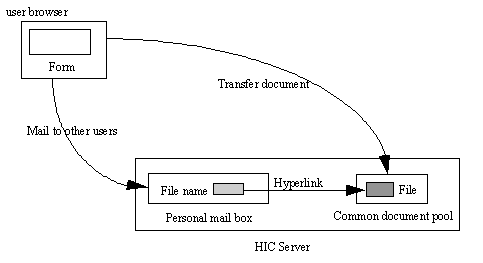
This function sends letters to individual users, and erases registered letters. If user ID's are known, letters can be sent in the form of text or HTML; whilst and documents other than letters can also be dispatched.
Term/abbreviation inspection:
An enormous quantity of terms and abbreviations are generated during the course of implementing large-scale projects like HAN/B-ISDN. Such terms and abbreviations are gathered, sorted and managed by HIC. All terms and abbreviations have been constructed through the use o f WAIS, and are browsed through by using the browser form.
Overseas Material Browsing:
This function creates the content required in each unit project into hot lists, and provides required information, including services related to documentation issued by standards organizations, such as ITU-T, ATM-Forum and IETF.
3.3 Scenario examples
HAN/B-ISDN Basic Interface Standard preparation process
The following is a description of the process-related scenario by which actual workers prepare HAN/B-ISDN basic interface standards through HIC.
1> Documents to be examined are entered into HIC, and Technical Examination Team registered in HIC for document examination is called.
2> Receipt of examiner opinions
Results of examinations carried out on documents whose examination has been requested are received through HIC. Based on this, pre-standards proposals are prepared, and sent to experts for further examination.
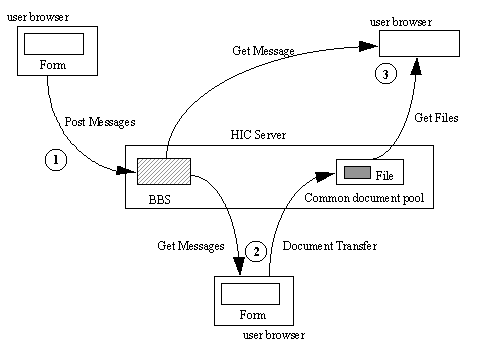
(2) Pre-standard proposals are thereby prepared and registered into HIC, and expert members scheduled to examine the documents are advised of the document outlines and examination period through the announcement, column.
(3) Each expert member examines these pre-standards proposals and prepares final interface standard proposals.
3> Basic interface standards proposal finalization and registration
The examined basic interface standards proposals are registered in HIC.
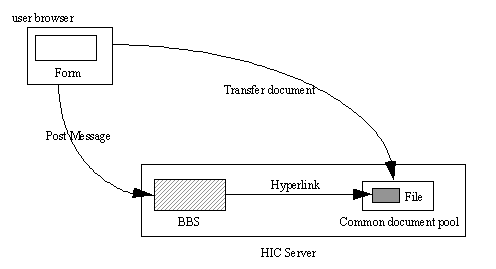
4.1 BBS
As the most fundamental function of HIC, electronic bulletin board has been provided. Because this function executes functions which are almost identical to those of the general type BBS we now use, and it is possible to prepare content, into HTML in addition to general text, actual hypermedia BBS functions can be executed. Currently, BBS content can be sorted by date and by user-id. The basic feedback function is composed of automatic announcement data renewal and announcement data erasure functions.
4.2 Document Management
In the HIC system, large quantities of technical documentation must be managed. Basically, documents are composed of titles, outlines, document numbers and document tests. All documents are prepared in MS Word 6.0, and these documents are stored in HIC in the form of HTML through the user forms, along with the fields mentioned earlier. Documents are searched, carrying each field value in a similar way to the existing search engines.
Up to 5 search words can be used when searching documents, and desired documents are discovered through the application of a variety of search systems associated with each search word.
To effectively manage the histories, the dates, times and file sizes of all documents, when being registered, are automatically recorded by this system.
4.3 Report Form Generation
Reports related to the progress of each unit project should be submitted in accordance with prescribed forms. In the case of HIC, a variety of reports are automatically prepared in report forms, and recalled, through the use of various features, such as the HTML table tag. At present, netscape is used, due to limitations, imposed by browsers through lack of advanced features.
4.4 Interactive Chat system
The Chat function has been implemented to enable communications and conferences to be held within individual closed groups. Functions comprise chatting room selection; the sending of user images; and the sending of content: viz, the system generally used nowadays.
4.5 Information support
A function capable of systematically gathering, arranging and providing the documents issued by the variety of standards organizations required in B-ISDN development, this function provides, after DB-form formulation, DB, ITU-T documents related to SG1 through SG15; IETF RFC documents; and ATM forum related documents. In addition, the function prepares overseas information hot-lists through the use of its robot program, and renews these lists on a regular basis.
The WWW highlighted lately has opened a hyper-information era. Currently, WWW is making rapid progress throughout the world, and this thesis describes matters pertaining to the examination and implementation of methods capable of providing consensus through the use of WWW.
The consensus management function centralizes thinking and translates information, enabling generation and acceptance of effective opinions,
and, during the process, has become the most important element in organizational development. The consensus management system currently
under implementation is connected to each HAN/B-ISDN project via Internets.
In addition, the ultimate target of this system is to realize operation of this system on the KIIT(Korea Information Infrastructure Test-bed),
scheduled to be fully tested in Korea starting July.
To realize this, the protocols currently used by WWW can be used as is by using the IP over ATM, or LAN Emulation, system or the new WWW protocols may be used on ATM LAN. Research with regard to this aspect is scheduled for the future.
In addition, the current document management function, because it uses a search engine in which all documents are stored simply in the form of HTML files using existing systems, contains a considerable degree of restriction on performance. However, if this system is revitalized, and considerable amounts of documents and opinions are exchanged, interface of commercial DBMS is planned, to ensure more effective document management. In addition, research is scheduled to be carried out also on real-time web application, for effective operation of CSCW [5] using HIC.
In conclusion, to ensure water-tight system security, appropriate security protocols will be developed and applied.
[1] Consensus Development Corperation, http://www.consensus. com:8300
[2] Yahoo List. http://www. yahoo. com/Computers/World _wide_Web/HTTP/Servers/Log_Analysis_Tools
[3] James Halana(1994). An Interactive Electronic Bulletin Board Implementation for Mosaic HTTP Servr. The second internal WWW conference '94.
[4] Nicholas Frega, Anthony Volpentesta(1994). A Multimedia Bulletin in the WWW Environment. The second internal WWW conference '94.
[5] CSCW. http://www11. informatik. tu-muenchen. de/cscw